

You may have heard of Taylorism. Type Taylor into your search box and Google begins to recommend Taylor Swift. Instead, try Encyclopedia Britannica:
Taylorism, System of scientific management advocated by Fred W. Taylor. In Taylor’s view, the task of factory management was to determine the best way for the worker to do the job, to provide the proper tools and training, and to provide incentives for good performance. He broke each job down into its individual motions, analyzed these to determine which were essential, and timed the workers with a stopwatch. With unnecessary motion eliminated, the worker, following a machinelike routine, became far more productive.
Taylorism is now an established practice, though rarely called by that name. The term resurfaces whenever a new technology threatens to treat humans like automatons or leads to deskilling of existing professions. This includes each new AI wave, as well as times when gig-workers reaching your door became the norm. It has also come up in the context of splitting human and robot-driven activities on the Amazon warehouse floor. Any serious work on automation cites Taylor: The Glass Cage by Nicholas Carr, a book I read a decade ago, discusses Taylorism as a historical antecedent of modern computer automation.
Taylor appeared again in a book I picked up a week ago: We are not machines, by Sarah O’Connor:
“One could argue the blueprint for Amazon’s workplace practices had been drawn up more than 100 years before by a man called Frederick Winslow Taylor…. It was the management of people, rather than tools, that came to obsess him. As he moved up the ranks, he became convinced that America’s factories were too antagonistic and inefficient.
The root of the problem, as he saw it, was that managers didn’t know as much as the workers themselves about how to cut metal, or fabricate steel, or whatever the task might be, since the workers had built up their knowledge through years of experience…. An economist would call this ‘information asymmetry’ and, for Taylor, it was a problem for two reasons.
First, workers had hundreds of slightly different ways of doing the same thing, rather than converging on the one best and most efficient way. Second, managers didn’t know how quickly most tasks could actually be completed, which meant workers were free to take it easy and produce far less than they were really capable of.”
I had to pause reading here. That first “problem” sounded ominously like what I see at my workplace today: individuals have different ways of doing the same task using generative AI tools, which seems inefficient. One of the productivity gains we are discussing involves moving from this “Individual AI” mode to an “Institutional AI” system, where a standard catalog of AI tools, practices, and reusable modules (like “skills”) makes such repetitive tasks more efficient.
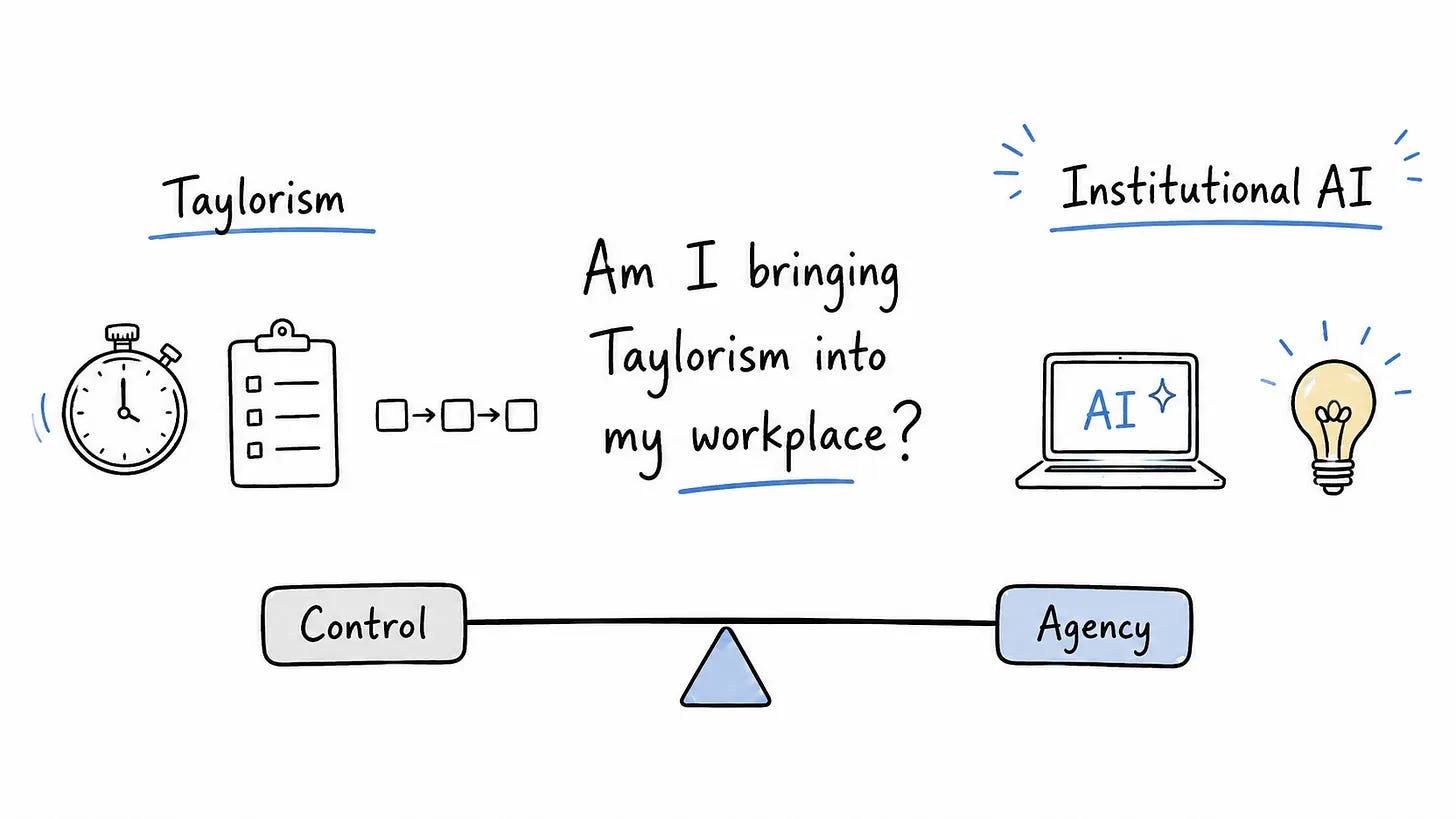
Thinking about this gave me a chill: was I bringing Taylorism into my workplace? On its own, this standardised approach can improve the individual knowledge worker’s situation.1 The issue emerges when it is coupled with the second “problem” Taylor identified. Or more precisely, the way he chose to solve this problem.
“... he sent managers with stopwatches and notebooks to the shop floor. They observed, timed and recorded every stage of every job, and determined the most efficient way that each one should be done. Under this new system, workers were told ‘not only what is to be done but how it is to be done and the exact time to be allowed for doing it.’
The system represented, in effect, the separation of mind and body, with the former now the exclusive domain of management…”
The knowledge-worker analogue here is the timesheet paired with a granular list of activities to record time on such a sheet. Together, these allow an organisation to measure the efficiency of each white-collar “activity”, both before and after introducing AI, thus enabling efficiency-driven targets similar to those thrust upon blue-collar workers on the factory floor.
At my workplace, there was an unsuccessful attempt to introduce timesheets some years ago. In spite of my misgivings, it may be attempted again. Right now, our attempts towards AI-driven efficiency improvements follow the guiding principle of retaining the agency of the user choosing to use AI for an individual task. For common organisational workflows, the principle is to keep the user – and not the AI agent – at the center, and automating the highly-repetitive and operational parts that need minimal human judgement. We see this emerging within processes like NGO Due Diligence and impact assessment projects. Measurement is still relevant, but at the aggregate, rather than individual, level.
Given the AI industry’s push towards more autonomous systems, the scene could look different a year from now. But I remain hopeful. While the intelligence frontier continues to evolve at an astonishing pace, the last couple of years have taught us that the bottlenecks are elsewhere. Workplaces are messy (mercifully!), tacit knowledge is hard to codify, and local contexts remain key to solving problems effectively. Perhaps AI can do more for our top line – with new products and services unimaginable before – than the bottom line that Taylor and his acolytes focussed on.
Instead of each user experimenting with general-purpose AI tools and figuring out the optimal solution, such a catalog can save time by offering “tried-and-tested” solutions where users need it.