

AI adoption among Indian nonprofits is a recurring theme in conversations these days. Reports from this sector about AI deployments, case studies, surveys and best practices now appear regularly in the news and on social media. All of this suggests, at a surface level, good momentum. Look beneath, and some interesting patterns emerge.
Project Tech4Dev’s AI cohort program has been my window into the explorations and pilots taken up by nonprofits over the last year. Across two instances of this program, I mentored one nonprofit in each cohort1. I observed the evolution of solutions that figured in both instances, listened to members and mentors of other nonprofit teams, and looked more closely at the details of their efforts. What emerged was a set of patterns and observations about AI adoption, spanning both technology and organisation dimensions.
Use-case and solution overviews
Project Tech4Dev’s AI Cohort 2.0 final report provides a good general overview of the program and the NGO use-cases. Click through the images below for a quick snapshot of each.


What the cohort reveals about AI adoption
These seven organisations, selected from a group of forty-two applicants, are likely more AI-ready than the sector at large. Their experiences therefore offer signals about early adoption, rather than a representative picture of nonprofit AI adoption in India.
1. The model’s capability is less differentiating than other solution variables
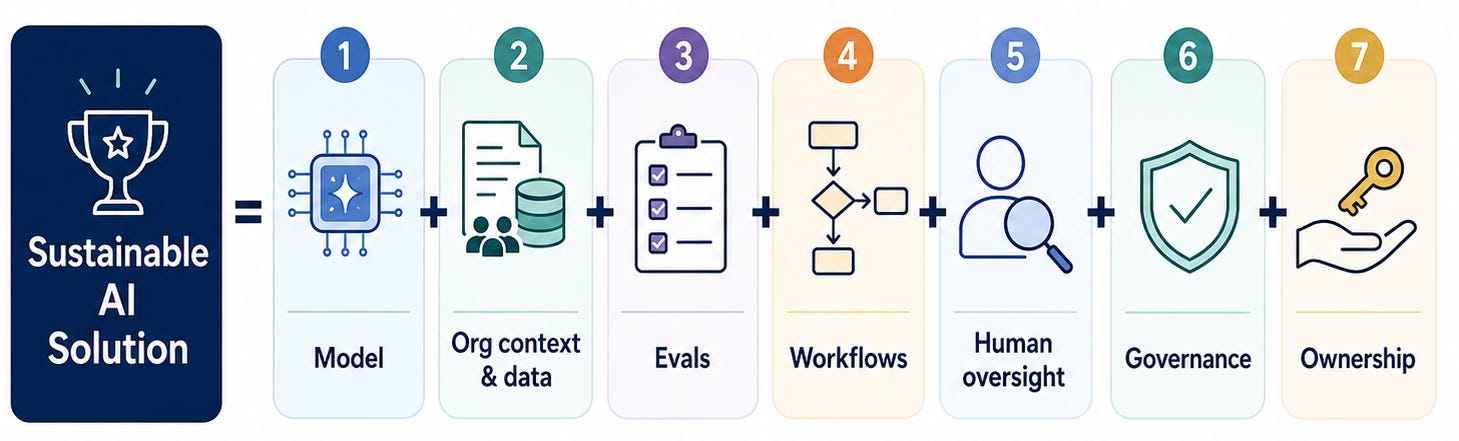
Across the solutions in cohort 2.0, what struck me was not the sophistication of the AI model, but the use-case-specific context and implementation choices: Madhi’s classroom observations; Reap Benefit’s curated action standards; Avanti’s longitudinal student information and evaluation approach; Inqui-Lab’s human-scored benchmark; U&I’s lesson plans, scheduling workflows and student logs; Samanvay’s workflow; and Glific’s product and support context. The pattern emerging here is:
Sustainable AI Solution = model + org context and data2 + evals + workflows + human oversight, governance, and ownership
This is broadly consistent with the present state of applied AI: access to capable models is easy, while redesigning workflows, creating trusted context, and enabling operational feedback loops remain a challenge. And these variables, not the model itself, are what separate a good solution from a poor one.
2. Marginal AI costs are low — organisational costs are likely higher
₹2/student/month, ₹1/student-report, $0.005/question, ₹2.5–4/mentor-session: these are some figures reported by teams in the cohort3.
The bigger costs revolve around data preparation, workflow redesign, user research, staff capacity, and ongoing product ownership and maintenance. Although the presentations do not quantify these organisational costs, the work described across the teams suggests that these efforts account for a larger share of the total implementation effort.
We have heard the other angle to this narrative: that a solid foundation of data, people, and processes are prerequisites to a successful AI implementation. The experience of this cohort suggests that the costs are also higher on that (non-AI) side of the equation.
3. Hybrid systems dominate more mature solutions
There is improved understanding now of where best to use LLMs, and where to adopt other approaches. Avanti uses deterministic code for numerical analysis. For some scenarios, Glific queries a database API to generate the response. U&I keeps Lesson Plan creation, volunteer scheduling and attendance entirely out of LLM scope. Samanvay’s requirements-to-application configurator translates semi-structured program specifications into structured software configuration.
The insight here is that LLMs appear most valuable for interpreting and synthesising information, supporting open-ended interactions, and converting unstructured inputs into machine-readable formats, while rules, calculations and transactional workflows are better served through deterministic approaches4.
4. Evaluation is becoming a core engineering practice
Evaluating LLM responses with the rigour of automated software testing is becoming more common. Unlike the first cohort, where the “Evals” topic was introduced and carried the whiff of novelty, several teams in the second cohort integrated it deeply into their engineering approach.
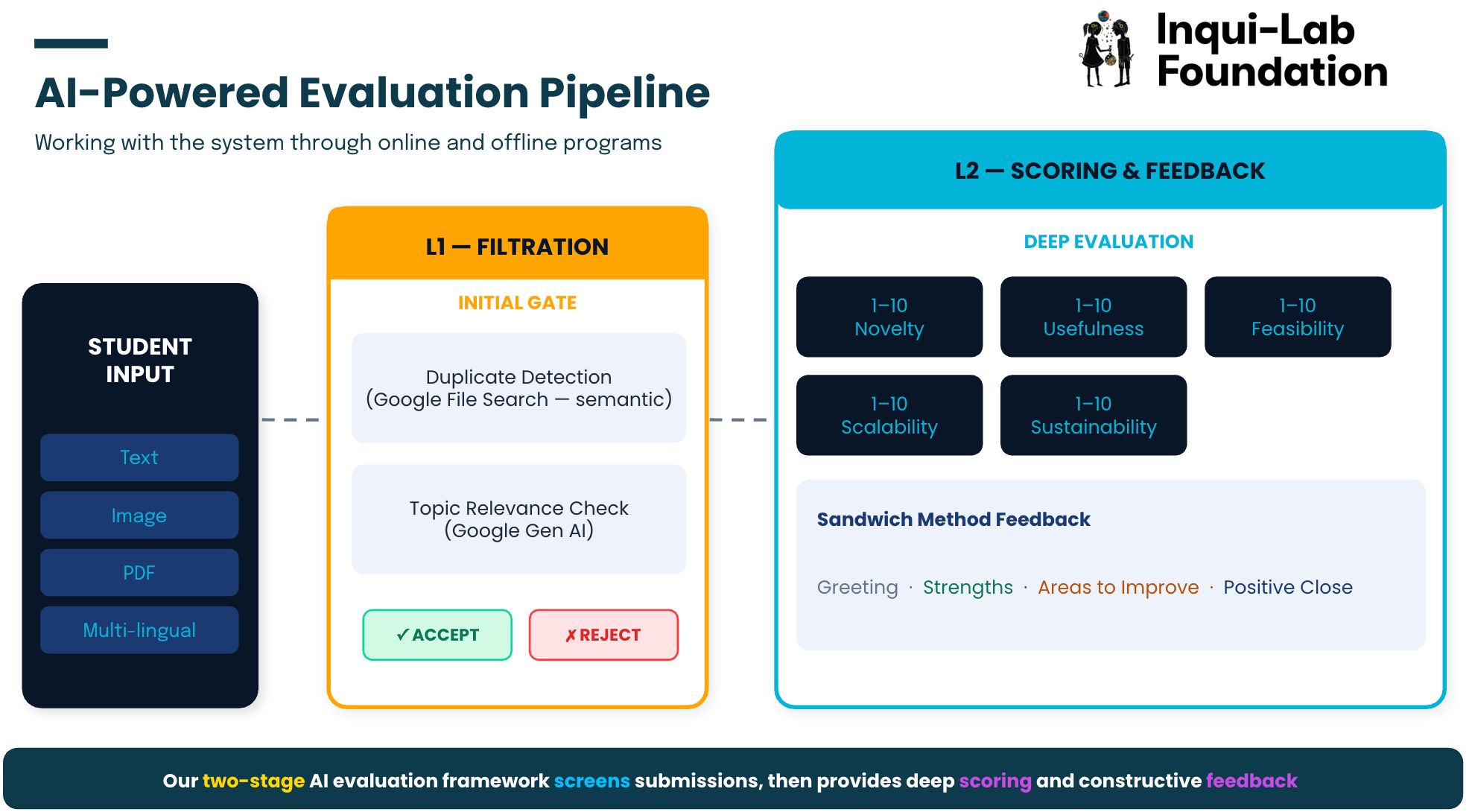
Madhi Foundation’s focus on latency is built into its continuous-integration pipeline: “Nothing ships without passing the eval suite.” Glific maintains a golden question set. Avanti Fellows built a golden set of 6 benchmark students on 6 criteria. Their mentor’s thesis that the Eval Layer is the Product also applies to Inqui-Lab, whose AI evaluation system makes it the product itself (not just the technique used to test their product).
5. AI sits mostly at the intermediary layer, not the last mile
Most solutions in the cohort primarily strengthen an intermediary layer—teachers, volunteers, mentors, implementation engineers and NGO administrators—rather than directly targeting last-mile interactions. The scarce resource being scaled is expert human time, which is the primary value targeted by the nonprofits. Given the sector’s capacity constraints, this is unsurprising.
There could be other reasons for this choice. These nonprofits are initially placing AI where professional judgement and institutional oversight can buffer failures. It may also reflect caution about exposing last-mile beneficiaries directly to AI-based systems. Nonprofits who have deployed medium-to-large-scale AI solutions to the last mile (like ARMMAN, Rocket Learning, Noora Health, or The Apprentice Project) are tech-first entities with a strong engineering foundation, well ahead of the curve on AI adoption.
6. Evidence of beneficiary impact trails technical progress
The nonprofit solutions in this cohort are still early in their lifecycle, but it is telling that the metrics reported across the seven nonprofits mostly cover operational themes: time saved, adoption, wait time, accuracy, cost per unit. There are few references to end-beneficiary outcomes5.
This is also a reflection of who is being targeted (not the last-mile beneficiary, as noted in the previous point). So the last-mile outcome is a downstream effect of these solutions, harder to reach and measure. But as these AI solutions mature, this is a dimension that cannot be ignored.
7. User research is still key
AI-enabled automation does not remove the need for established product-development practices. Understanding users through dedicated user-research is still key.
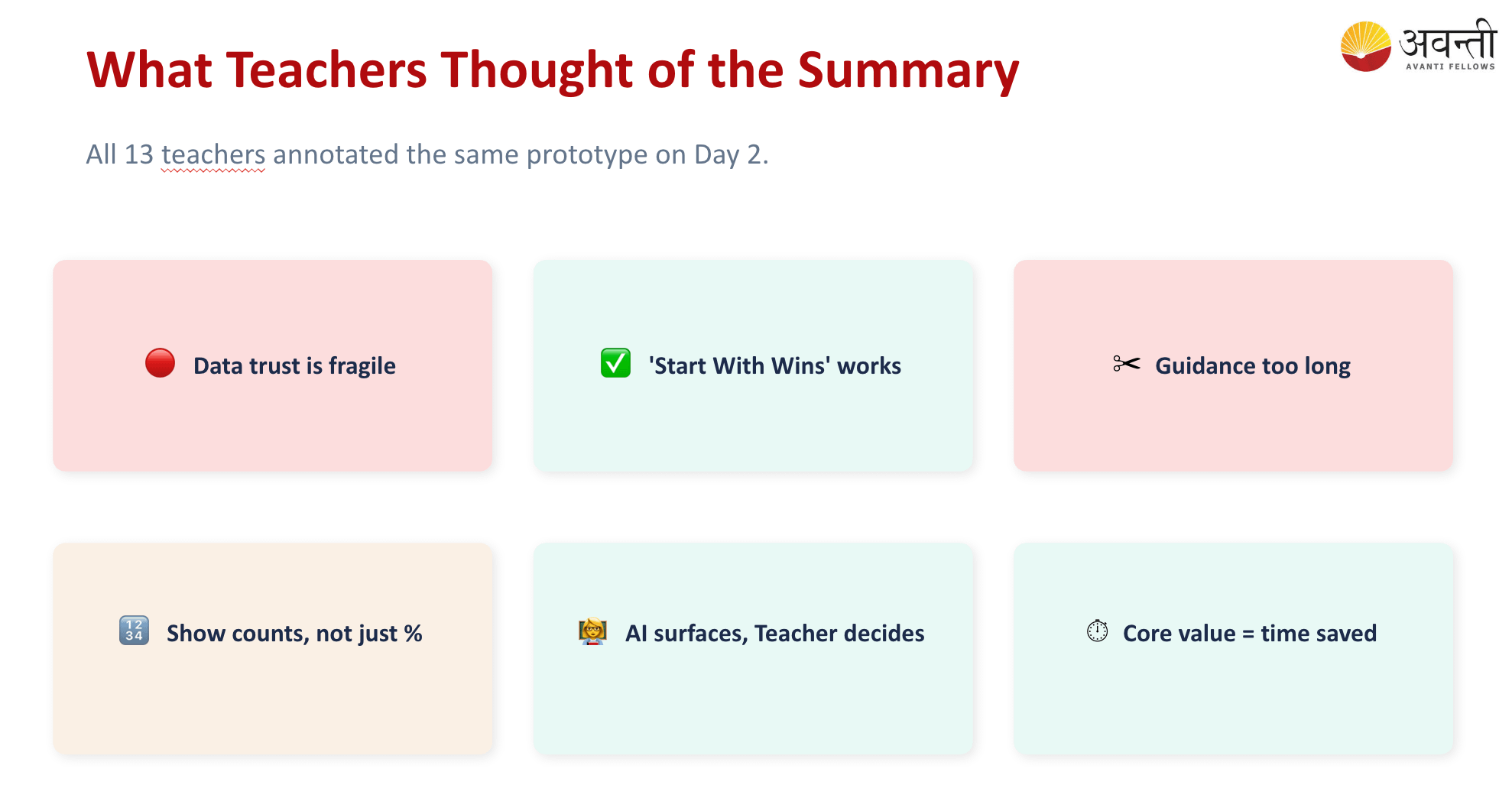
Some of the pivots in the cohort happened when teams spoke to users to validate initial hypotheses. Avanti’s two-day study with 13 teacher-mentors reframed the question from “how do we make the summary better” to what the mentor actually needs to walk in prepared: without it they’d have “fixed the wrong things faster.” Madhi’s interviews with teachers led to the approach of building a “second brain” for the teacher. User interviews by the U&I team resulted in a shift from custom AI-generated lesson plans to a standard lesson plan format.
8. Responsible-AI maturity is uneven
Across the cohort, teams treated Responsible AI through output validation and human oversight means rather than a rigorous compliance step. Avanti defined a “AI surfaces, teacher decides” rule, while also tracking hallucinations and redesigning guidance when accuracy was weak. Inqui-Lab retained teacher validation for AI-generated student assessments, and both Reap Benefit and Glific built escalation paths so unresolved or complex cases move to human mentors or support teams.
However, the cohort presentations do not explicitly mention bias testing, consent framing, grievance redressal, or safeguarding protocols. The input from Tattle, a knowledge partner in the program, appears to have stayed mostly at an awareness level.
9. Shared infrastructure creates compounding value
Most cohort solutions improve a specific programme or organisational workflow, but Samanvay’s approach is different: Avni AI extends an open-source platform already used across organisations and sectors. By reducing the effort required to translate programme requirements into working applications, each improvement can be reused by multiple nonprofits rather than rebuilt separately.
This suggests an important role for AI in the social sector: not only making individual organisations more efficient, but strengthening shared digital infrastructure that lowers the cost and technical barriers to adoption across the ecosystem.
10. Voice adoption has just begun
Only Madhi Foundation has integrated voice into their solution (in the form of voice-based journaling). Two others – U&I and Inqui-Lab – mention Voice AI on their roadmap.
Voice carries the potential to reduce literacy and language barriers, improve frontline data capture, and enable broader reach. The cost of a voice AI call has come down to ₹4-6/minute, and transcribing voice to text is also inexpensive6. It will be interesting to see how this medium gets adopted by nonprofits in future.
The road ahead
Across these seven early pilots, AI adoption is becoming less about the model and more about the plumbing: trusted organisational context, reliable evaluations, well-designed workflows, human oversight and sustained product ownership.
The next maturity transition will require progress in several areas, including domain-specific evaluation standards, a stronger focus on responsible AI, the operational efficiency required for scale, controlled comparisons with existing programme delivery, and clearer links to beneficiary outcomes.
But perhaps the most important lesson from the cohort is a sobering one. The AI transition will be a long haul: there are no shortcuts. Every use-case will have to be defined with the rigour that all good software demands, built with the engineering discipline needed to manage LLM shortcomings, reviewed and validated by humans, governed with a responsible AI focus, and evaluated not only for efficiency but also for real social outcomes. And all this must be backed by strong organisational capability and leadership support.
After four months, the teams in this AI cohort program are just getting started. While the pace of AI model development is unprecedented, it is just one variable in the solution.
Better models will improve underlying intelligence. But the real work lies within the other variables. Getting them right will take skill, time and money.
Simple Education Foundation in the first one, U&I Trust in the next.
The organisational context here spans different types of assets, including curated curricula, historical knowledge-bases, scoring rubrics, structured student records (and other MIS), test scenarios, etc.
An important reason for the lower running costs is the adoption of “Evals”. As Malaviya, Avanti’s mentor writes, safety and affordability are linked.
This boundary between LLM and non-LLM aspects of the solution is also a sign of current AI maturity.
Reap Benefit mentions that they have “early signs” that AI is driving quality action, not just activity. Avanti reports students seeking mentorship bottom-up, after AI “summaries surfaced their performance gap.”
Sarvam AI's speech-to-text API costs ₹30 per audio hour
Thanks for the detailed post. Very helpful insights towards responsible AI governance and also costing .